



Pet nutrition buyer knowledge
Explore 132 original answers covering product development, daily handling, quality documents, packaging and OEM/ODM project control.
Buyer knowledge
Answers support product planning and informed discussion. Ask a veterinarian about an individual animal's health or feeding needs.
100 questions
Should a new pet supplement brand begin with one SKU or a range?
Begin with one defined species, serving and use occasion. A small range can follow once the first product's format, pack and evidence are understood.
What makes two nutrition concepts genuinely different to a buyer?
Their intended animals, feeding routines, measured contributions and package use should differ clearly. A flavour change alone does not explain two nutritional propositions.
Can a pet food brand add a supplement without changing its core food?
It can discuss a complementary product, but the supplement brief must account for the base diet and proposed daily serving. Final classification and claims need market review.
How can a retailer decide whether a chew or powder deserves shelf space?
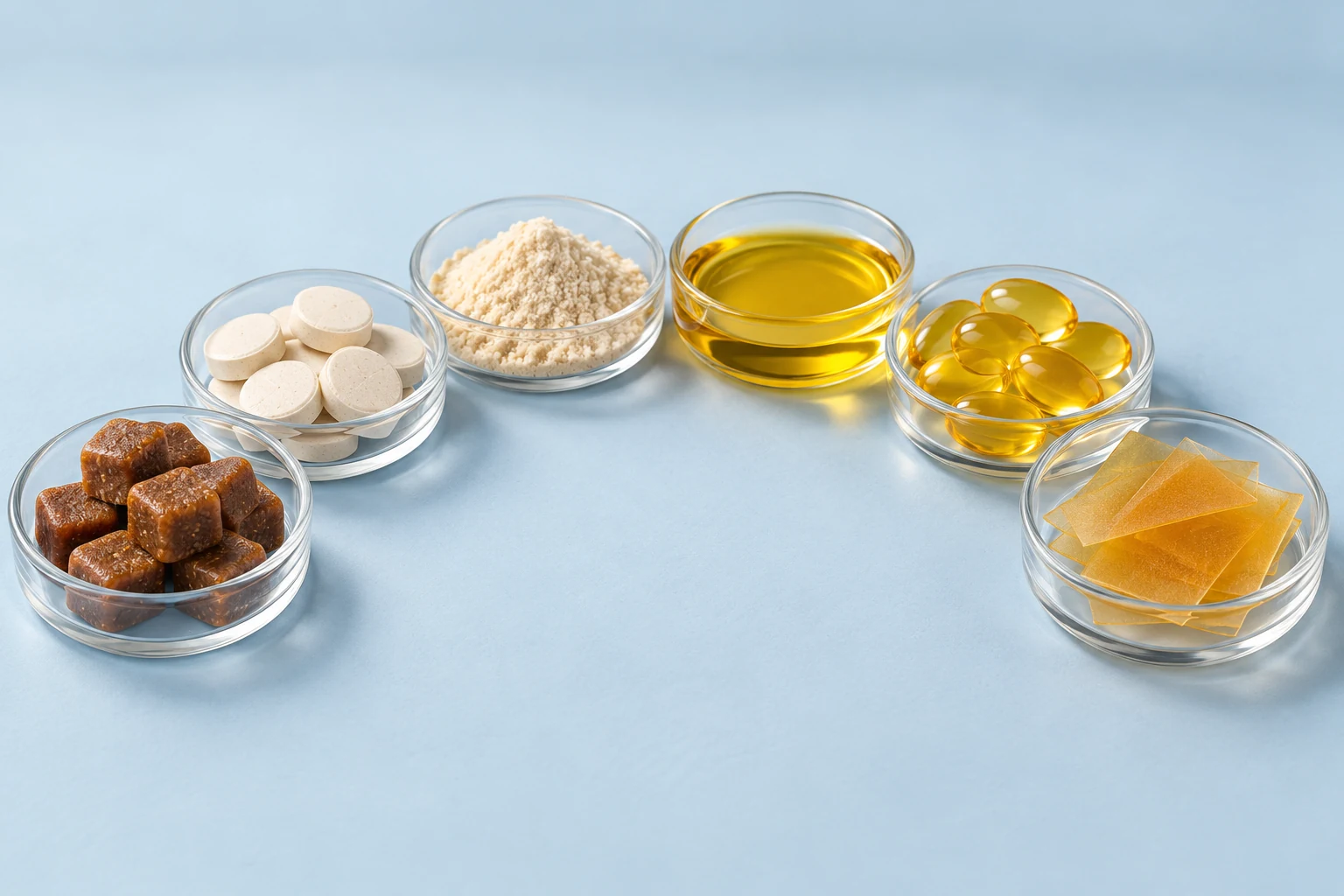
Compare how the owner will give it, how the amount is measured and what the label can support. Ask for a sample and specification before deciding from a render.
Can dog and cat variants share a brand identity?
Yes, but the species-specific formula, directions and pack text need separate assessment. Do not assume that a dog serving transfers to a cat.
What information should a first product concept sheet contain?
Include target species, intended nutrition purpose, selling country, proposed serving, preferred format and pack. Mark ingredient amounts and claims that still require review.
How should a brand name be tested against a product brief?
Check whether the name suggests a treatment, species or ingredient claim that the finished product cannot substantiate. Keep name approval with the label review.
When is a private label reference useful?
A reference can help compare format, pack and handling before commissioning custom development. Its formula and market fit still require project confirmation.
Can the same concept be sold in several markets?
Market-specific ingredients, labels, claims and import requirements need review for each destination. Translation alone does not complete that review.
How should a brand describe a wellness direction without promising treatment?
State the intended nutritional role and measured serving, then review proposed wording against product evidence and local rules. Avoid disease or emergency language.
Why should the daily serving be fixed before the ingredient list?
It tells the formulator how much material must fit into each unit. It also lets the buyer compare formats using the same intended contribution.
What is the difference between raw ingredient weight and active contribution?
An extract or oil can contain only a fraction of the nutrient named on the label. Record both the material amount and the measured contribution where relevant.
Should a formula brief give percentages or amounts per serving?
Give amounts per unit and daily serving, with percentages when they help define the blend. A percentage without a serving size is difficult to assess.
How can a buyer flag an ingredient that may be difficult to source?
Mark its required specification, acceptable alternatives and whether substitution needs written approval. Ask for availability before final artwork is released.
What needs review before adding a flavour to a pet product?
Check species suitability, the finished serving, palatability, stability and destination-market label treatment. A human food flavour description is not enough.
Can one formula cover puppies, adult dogs and senior dogs?
Life-stage suitability should be assessed against the full formula and feeding directions. A broad label should not be inferred from one adult-dog concept.
How does a target serving affect soft-chew size?
Ingredient load, chew matrix and texture all occupy mass. A small target piece may not carry the proposed amount without changing the formula or serving count.
When should a brand request a formula revision number?
At the first approved technical brief, and whenever ingredient identity, ratio or processing assumptions change. Link quotes, samples and labels to that revision.
What should be recorded when a supplied ingredient is replaced?
Record the old and new identity, specification, amount, reason and effect on declared content or claims. Recheck the sample and quote scope.
Why is an attractive ingredient story insufficient for a label claim?
The finished product has a specific amount, format and serving. Evidence from an ingredient alone may not apply directly to that finished product.
What should be observed in a pet palatability check?
Record the animal, amount offered, method of offering, repeated acceptance and any refusal. A single photo of a pet taking a treat is not a study.
Why test a supplement in its final pack?
Opening, odour, texture and measuring can change the owner experience. A loose sample does not show how the product behaves after normal storage and use.
Can a powder be sprinkled on every type of food?
Its dispersion, taste and serving instructions must be assessed with the intended feeding routine. Do not generalize from one mixing test.
What if a dog swallows a chew without chewing?
The directions and product design should account for realistic use and size. Discuss this in the format review rather than assuming every animal chews slowly.
How can a brand reduce owner dosing errors?
Use a countable unit, clear measuring device or precise scoop instruction. Test the directions with the actual package and serving size.
Is a dropper automatically a precise dosing device?
Precision depends on liquid properties, the dispenser and user technique. Specify the intended amount and verify it with the final bottle and dropper.
Should a cat product be judged by the same aroma panel as a dog product?
No. Evaluate the intended species and method of offering. A pleasant smell to a human or dog does not establish cat acceptance.
When does a single-dose sachet improve use?
It can remove a measuring step when each sachet contains one intended serving. Check tearability, powder flow and storage protection in the final pack.
What should a use trial record beyond acceptance?
Note how often the owner used the product, whether the amount was measured correctly, and any handling problems. Separate those observations from efficacy claims.
Can an owner-facing instruction say “as needed”?
A vague direction may encourage inconsistent use. Define a serving and frequency for technical and market review before printing.
What is the first feasibility question for a pet oral film?
Ask whether the intended ingredient amount, film size and handling properties can coexist. The film base uses space too.
Can several flavours share one oral-film minimum?
The confirmed minimum is 60,000 films per SKU. A change of flavour or formula may create a separate SKU; define it in the quote request.
Why might an oral film need an individual primary pack?
Moisture and handling can affect a thin film. Confirm protection with the actual formula and intended storage route.
Can a human oral-film study predict a pet nutrition film's absorption?
No. Species, ingredient, formula and study conditions differ. Any published human or animal drug study is background for technology, not proof for this product.
Is a fast-dissolving film always the best option for a cat?
Acceptance, loading, administration and owner handling all need evaluation. A powder or liquid may fit the same brief better.
What should a film specification state?
Agree dimensions, unit content, appearance, packaging and relevant acceptance criteria. Final characteristics depend on the project formula.
Can film thickness be chosen from a catalogue picture?
No. Thickness relates to material load, handling and performance and needs feasibility work with the intended ingredients.
How should a buyer compare a film with a chew?
Compare daily ingredient contribution, number of units, palatability and packaging effort for the same intended use. Do not compare only unit appearance.
Does a 15-film reference carton fix the final pack count?
No. Pack count is a project choice. Our usual discussion covers roughly 10 to 20 films per box, subject to the final brief.
What should happen if a film sticks to its wrapper?
Treat it as a product and packaging compatibility issue. Review formulation, sealing and storage conditions before approving a commercial pack.
How should a buyer estimate a powder's retail pack size?
Multiply the measured daily serving by the proposed number of days, then allow for the chosen pack and filling specification. Confirm final net quantity with the formula.
What does the 50 kg powder minimum mean for bottle count?
The count depends on grams per retail unit and fill loss assumptions. It cannot be stated as a fixed number of bottles without a pack size.
Can soft chews and nutritional treats share the 100 kg minimum?
Both start at 100 kg, but formula, flavour and mixed-order conditions are confirmed per project. The number of retail packs depends on chew weight and count.
Why does chew water activity matter?
It affects texture and storage behaviour. Agree appropriate specification and packaging with the finished formula rather than using a generic shelf-life claim.
Can a tablet be split to create a smaller pet serving?
Only if the formulation and tablet design support accurate division and the directions are reviewed. Do not infer divisibility from a score line alone.
What should a powder scoop be checked against?
Check the mass it delivers with the finished powder under realistic filling and levelling. Volume marks alone do not prove a gram amount.
How do sachets change a powder quotation?
They add film, printing, filling and count assumptions. State sachet fill mass and units per carton when requesting a quote.
Can a soft chew contain an oil-based ingredient?
It may be technically possible, but the amount, dispersion, stability and texture need assessment. Request a formula feasibility review.
What if a tablet has a strong ingredient odour?
Consider palatability, coating or another format, but reassess the whole serving. An appearance change does not remove the need for acceptance testing.
Why compare grams per chew before discussing bottle price?
Chew mass determines how many pieces a 100 kg batch may yield. It also affects daily serving and retail pack count.
What should an omega oil brief specify beyond bottle size?
State oil type, proposed EPA and DHA contribution, daily serving, oxidation-related specification and dispenser. The finished label needs market review.
How should a buyer compare an oil with softgels?
Compare actual fatty-acid contribution per daily serving, handling and pack protection. The amount of total oil is only one part of the comparison.
Do drops and gummies both start at 1,000 bottles?
Yes, based on current confirmed commercial terms. Formula and pack details still determine a project quote.
Can a liquid and powder use the same ingredient claim?
Only after reviewing the amount and evidence in each finished format. A shared ingredient name does not make the two products equivalent.
What can affect a dropper bottle after opening?
Repeated exposure to air, light and handling can matter. Define storage and in-use evaluation for the selected formula and pack.
How should softgel count be chosen?
Work back from the intended daily serving and days per pack. Capsule size and fill feasibility then need project assessment.
What should a fish-oil COA be matched to?
Match the exact oil, batch, declared fatty-acid content and relevant quality specification. A generic fish-oil sheet may not cover the finished pack.
Can a water-based drop formula be substituted for an oil formula?
That changes ingredient compatibility, preservation, dispensing and specifications. Treat it as a new formulation review.
Why does bottle material matter for oils?
Material and closure can affect protection and usability. Confirm the selection with the specific formula and distribution conditions.
What if a capsule is too large for the intended pet?
Revisit the serving or format. A smaller capsule may require multiple units or a different formulation approach.
What is the difference between primary and secondary pet supplement packaging?
The primary pack directly contains and protects the product; the outer carton carries presentation and additional text. Both should be defined in the brief.
When should label artwork receive a formula version?
From the first controlled proof. It lets reviewers catch declarations that refer to an earlier ingredient ratio.
Why verify date coding on a filled pack?
A code can become hard to read on a curved bottle or textured seal. Check location and legibility with production-representative material.
Can a single carton design cover two species?
Only if each product's formula, directions and market text remain clear and compliant. Shared graphics do not justify shared technical copy.
What belongs in a packaging quotation request?
Provide primary pack, outer pack, count, net amount, print languages, artwork responsibility and proposed quantity. Flag any sustainability requirement for material review.
Should a QR code link to an unfinished product page?
No. Check the destination, ownership and long-term maintenance before printing a code. Avoid linking to a supplier identity page unintentionally.
How should a buyer check a sachet tear notch?
Use a physical sample and confirm the tear path does not damage the seal or spill product. Review it with users who will actually open it.
Can printed packaging be ordered before a formula is approved?
It creates a risk of obsolete declarations and pack dimensions. Align formula, specification and market text before a print commitment.
What should a multilingual pack proof show?
Show real text lengths, type sizes and direction for each market language. Arabic and CJK scripts should be inspected in the final layout.
Why keep the dieline in the quality file?
It defines the printable and seal areas for the approved pack. A later artwork revision can then be checked against the same physical layout.
Can a COA from an ingredient supplier replace a finished-product COA?
It answers a different question. Keep ingredient evidence separate from the finished batch documentation and define what each document supports.
What should be compared between a specification and COA?
Check product identity, revision, test item, method, unit, limit and result. Resolve mismatches before treating the batch as conforming.
Is a “passed” test result enough without a method?
The method and reporting basis affect interpretation. Ask for the full report or specification context when the decision depends on the result.
How is a third-party mycotoxin panel selected?
Choose analytes and limits from ingredient risk, product use and destination requirements. Scope, laboratory, cost and timing are agreed per project.
Can a heavy-metal report support every SKU in a range?
Only if its sample identity and testing scope cover those SKUs. Different formulas or batches may require separate review.
What should be checked when a sample is sent to a laboratory?
Record sample identity, batch, packaging, requested analytes and chain of custody. The report should be traceable back to the submitted material.
Does a laboratory test prove palatability?
No. Chemical and microbiological results do not show whether a dog or cat will accept the finished product.
What does “human oral-film production standard” establish?
It describes the user-confirmed production approach for oral films. It does not by itself establish pet safety, efficacy, approval or a specific certification.
When should stability be discussed in a new product?
Before choosing final packaging and shelf-life wording. The required study design depends on formula and intended storage conditions.
Can an old test report be reused after an ingredient change?
Review whether the change affects the characteristic tested. Record the decision and commission new testing when needed.
Can a pet supplement label promise to cure a disease?
Such wording can change product classification and requires specific review. Our nutrition concepts are described as nutritional support, not treatment.
What should be done with a supplier brochure's absorption percentage?
Identify the exact study, product and conditions before using it. Do not transfer a percentage to a different pet nutrition formula.
Is “clinically proven” suitable when only an ingredient paper exists?
The finished product and proposed claim need their own evidence review. An ingredient paper alone should not be presented as a finished-product trial.
Can a product be called approved because a facility is registered?
Facility registration and product approval are different matters. Check the actual jurisdiction and product-specific documents.
How should a proposed probiotic count be written?
Specify organism identity, unit, amount per serving and the point in shelf life to which the count applies. Confirm the finished-product test plan.
What should a brand do if market claims differ between countries?
Maintain market-specific approved text and artwork revisions. Do not assume that a translation is legally equivalent.
Does “natural” remove the need for ingredient review?
No. Identity, level, species suitability and market rules still matter for each ingredient.
Can a nutrition product be advertised for poisoning emergencies?
No. Emergency treatment claims are inappropriate for an unverified nutrition product; urgent animal health concerns belong with a veterinarian.
What should an educational article say about a formula still in development?
Use conditional language and distinguish a concept from a tested finished product. Do not state efficacy, shelf life or approval as settled.
How should a brand use a third-party test report in marketing?
Describe only the analytes, sample and result actually tested, with the report's date and scope. Avoid turning a narrow result into a blanket safety claim.
What information starts a useful OEM discussion?
Send species, concept, proposed ingredients and amounts, pack, market and expected quantity. Mark decisions that need technical review.
How long does new-formula costing take?
About one to two days after the formula ratios and packaging brief are clear. This is an initial costing window, not sample or delivery time.
Can a quotation be issued without a packaging choice?
A provisional scope can be discussed, but a comparable project price needs pack assumptions. We do not publish a universal rate card.
What is the oral-film order minimum?
The confirmed minimum is 60,000 films per SKU. Define formula, flavour and pack before interpreting a SKU.
Can several different formulations be combined to meet an MOQ?
For oral films, the minimum is per SKU. Mixed-order rules for other formats need project confirmation.
Can a buyer arrange a video visit to the production base?
A video visit to our production base in China can be coordinated. Scheduling and what can be shown are agreed for the project.
Are product samples always in stock?
Availability, sample cost and shipping are checked for the requested item and destination. A reference photograph does not establish stock.
What does an OEM purchase order need to identify?
Record formula revision, specification, pack, quantity, artwork version, agreed tests and delivery terms. Confirm any change in writing.
When should a brand ask for a revised quote?
Ask after changing ingredient ratios, format, count, pack or order volume. Keep the revised scope tied to its quote version.
What should be agreed before shipping samples abroad?
Confirm available sample, recipient details, destination, freight and any required documents. Do not infer customs eligibility from a product catalogue.
No matching questions. Try a broader word.
Bring us your next product idea.
Tell us the animal, nutrition direction, intended market and preferred format. We can help define the formula and packaging questions for a useful proposal.